
The Legend of the Black Bitch
Linlithgow's Most Loyal Resident
Walk around Linlithgow and sooner or later you'll meet a black dog.
You'll find her on signs, buildings, badges and carvings. She appears throughout the town, has represented Linlithgow for centuries and her story has been passed from one generation to another.
And people born in the town have traditionally carried her name with pride.
They are Linlithgow Black Bitches.
To someone encountering the name for the first time, that can come as something of a surprise.
But in Linlithgow, being a Black Bitch is an honour.
Behind the unusual name lies one of the town's oldest and best-loved legends — a story of loyalty, bravery and faithfulness.
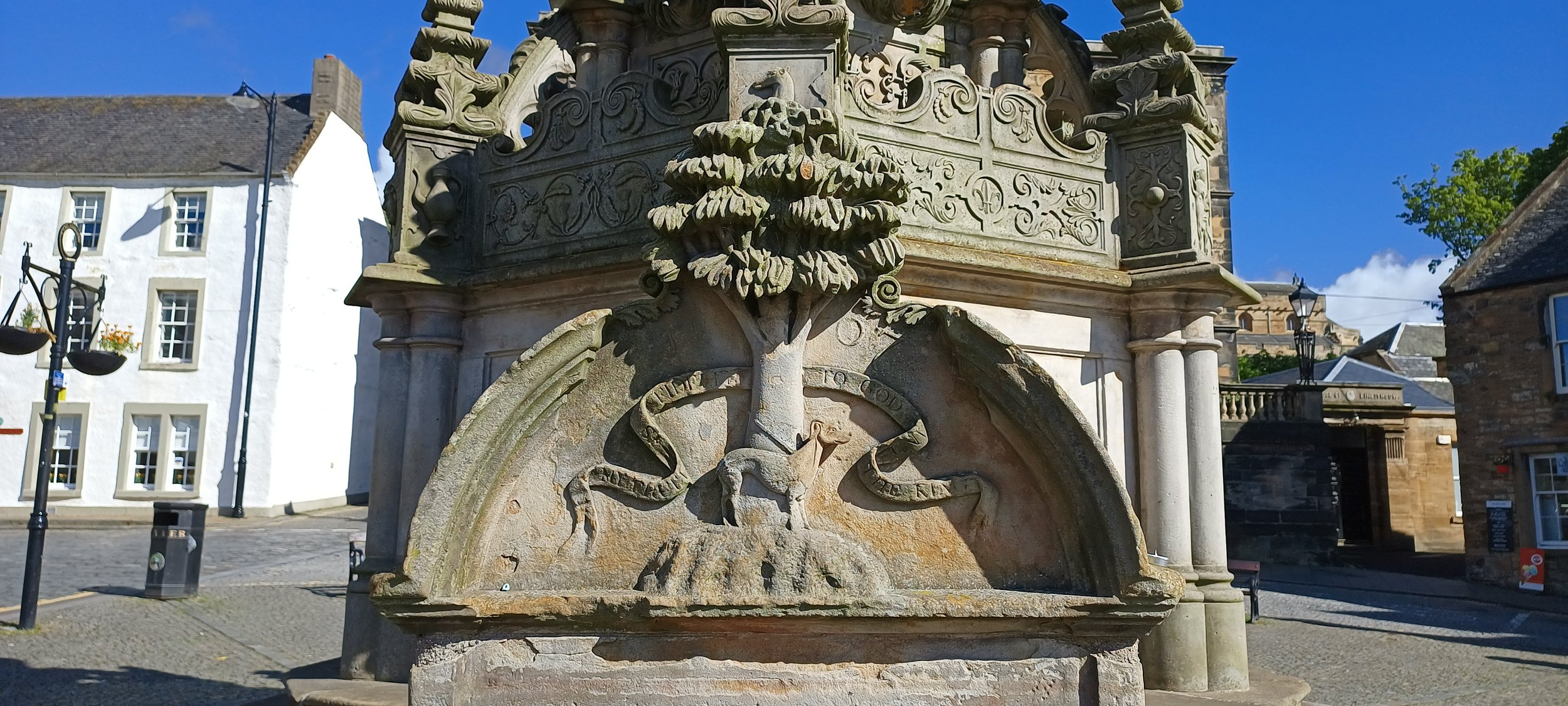
Linlithgow Cross Well with Black Bitch Carving
The Loyal Hound
According to the traditional story, many centuries ago a man was convicted of a crime in Linlithgow.
His punishment was particularly cruel.
He was taken to a small island in Linlithgow Loch, chained to a tree and left without food or water to die.
But something strange happened.
Days passed.
And the prisoner remained alive.
The authorities couldn't understand how he was surviving, so they began watching the island more carefully.
Eventually they discovered his secret.
Every night, his faithful black female greyhound was swimming across the loch to reach him, carrying food and water to help her master survive. This is the version preserved in earlier Linlithgow Museum interpretation and remains the best-known version of the legend in the town.
When the authorities discovered what was happening, they captured the dog.
According to the legend, she too was chained to the tree and left to die.
But the people of Linlithgow didn't forget her.
Her loyalty, courage and determination became qualities associated with the town, and the image of the black dog chained to an oak tree became one of Linlithgow's most enduring symbols.
Legend or History?
It's a wonderful story.
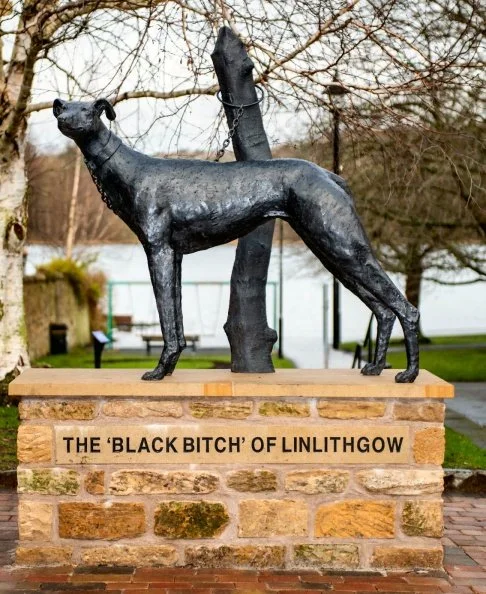
The Black Bitch Statute
But did it actually happen?
We simply don't know.
Like all good legends, the story of the Black Bitch has changed and developed as it has passed through generations.
The faithful hound bringing food and water to her condemned master is the version most familiar in Linlithgow today, but she isn't the only Black Bitch to appear in local storytelling.
Another version tells of a mother greyhound swimming across the loch to care for her puppies on an island.
One tells of a dog raising the alarm when fire threatened the town.
And then there's perhaps the most unexpected explanation of all:
a local witch who could transform herself into a female dog.
Quite how the witch became involved is another question entirely.
People have been trying to explain Linlithgow's mysterious black greyhound for a very long time. By the 1790s, even the Statistical Account of Scotland could provide no satisfactory explanation for how the dog had come to form part of Linlithgow's armorial bearings.
So the mystery isn't new.
Linlithgow people have apparently been asking “Why do we have a Black Bitch?” for more than two centuries.
A Royal Connection?
There may also be a rather more practical explanation.
Linlithgow was an important royal centre, and the countryside surrounding Linlithgow Palace was used for hunting by Scotland's kings.
Hounds — including greyhounds — were associated with royal hunting, and dogs were kept at Linlithgow Palace.
One interpretation suggests that the different elements of the Black Bitch emblem represent this landscape: the greyhound representing the royal hunting dogs, the tree the surrounding royal forest and the water Linlithgow Loch.
We may never know whether this was the original inspiration for the emblem or whether the much-loved legend developed later as people tried to explain it.
Either way, Linlithgow got a very good dog out of it.
One Town, Two Coats of Arms
Linlithgow has the unusual honour of having two historic coats of arms.
One belongs to St Michael, the town's patron saint. The other belongs to the Black Bitch.
She doesn't simply appear as one part of another coat of arms. The black female greyhound chained to her tree is an emblem in her own right.
Both St Michael and the Black Bitch have deep roots in Linlithgow's civic history, with their imagery appearing on the town's ancient burgh seals.
So while we may never be able to prove exactly how the legend began, the Black Bitch's place in Linlithgow's history is certainly no recent invention.
She has represented the town for centuries.
And she hasn't always looked exactly the same.
Over the years there have been many different representations of the Black Bitch. Sometimes she faces in a different direction, her position changes and the details of the tree, island and loch vary.
But the dog herself has endured.
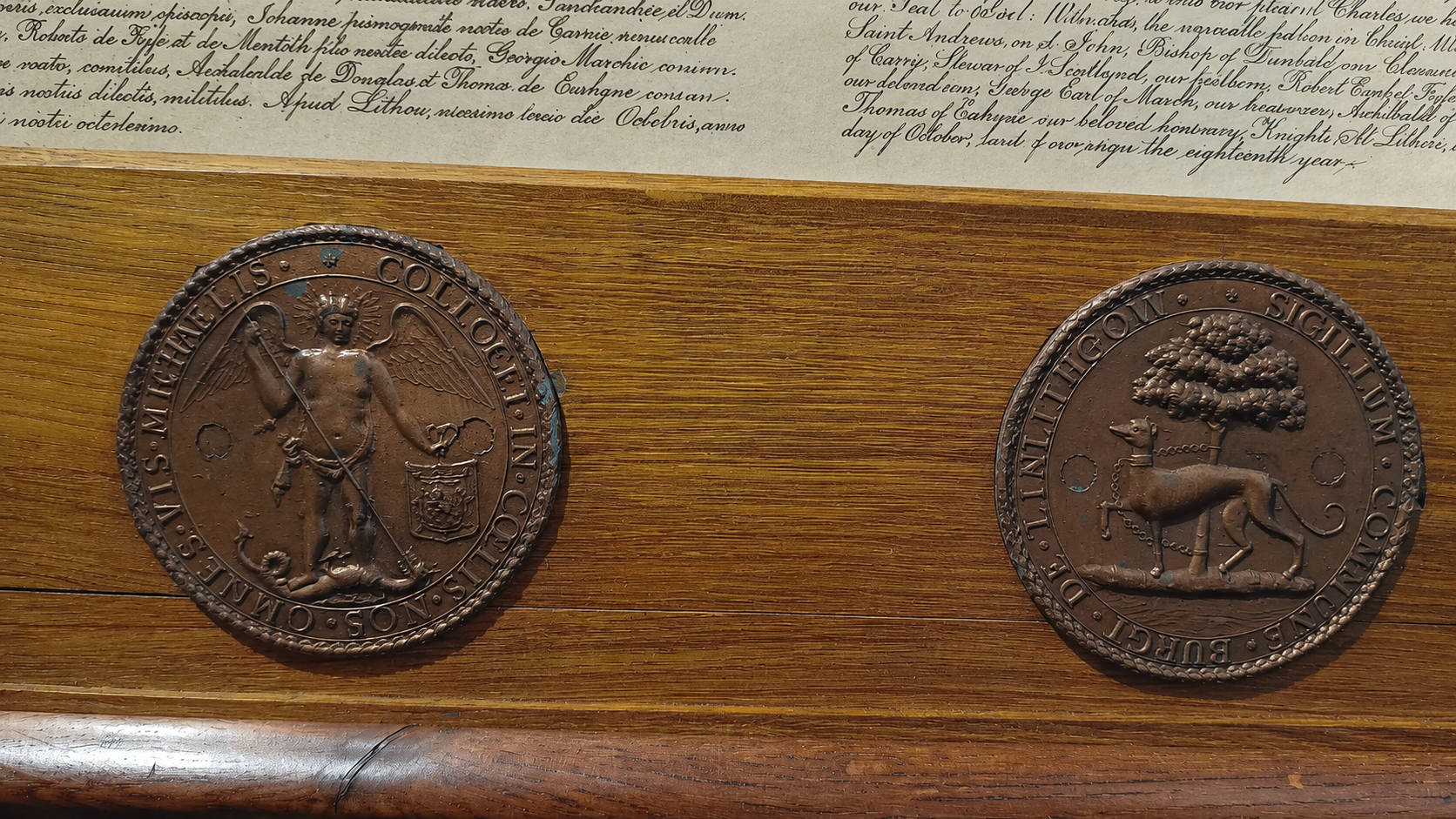
Linlithgow’s Civic Insignia
Loyalty, Bravery and Faithfulness
Perhaps the reason the loyal-hound story has survived for so long is what the dog represents.
She refuses to abandon her master. She repeatedly crosses the loch to help him. And ultimately, according to the legend, she pays for that loyalty with her life. Over generations, the people of Linlithgow came to embrace those qualities as their own: loyalty, bravery, determination and faithfulness.
Her motto says it rather more simply:
Fidelis — Faithful.
And that gave rise to another rather unusual Linlithgow tradition.
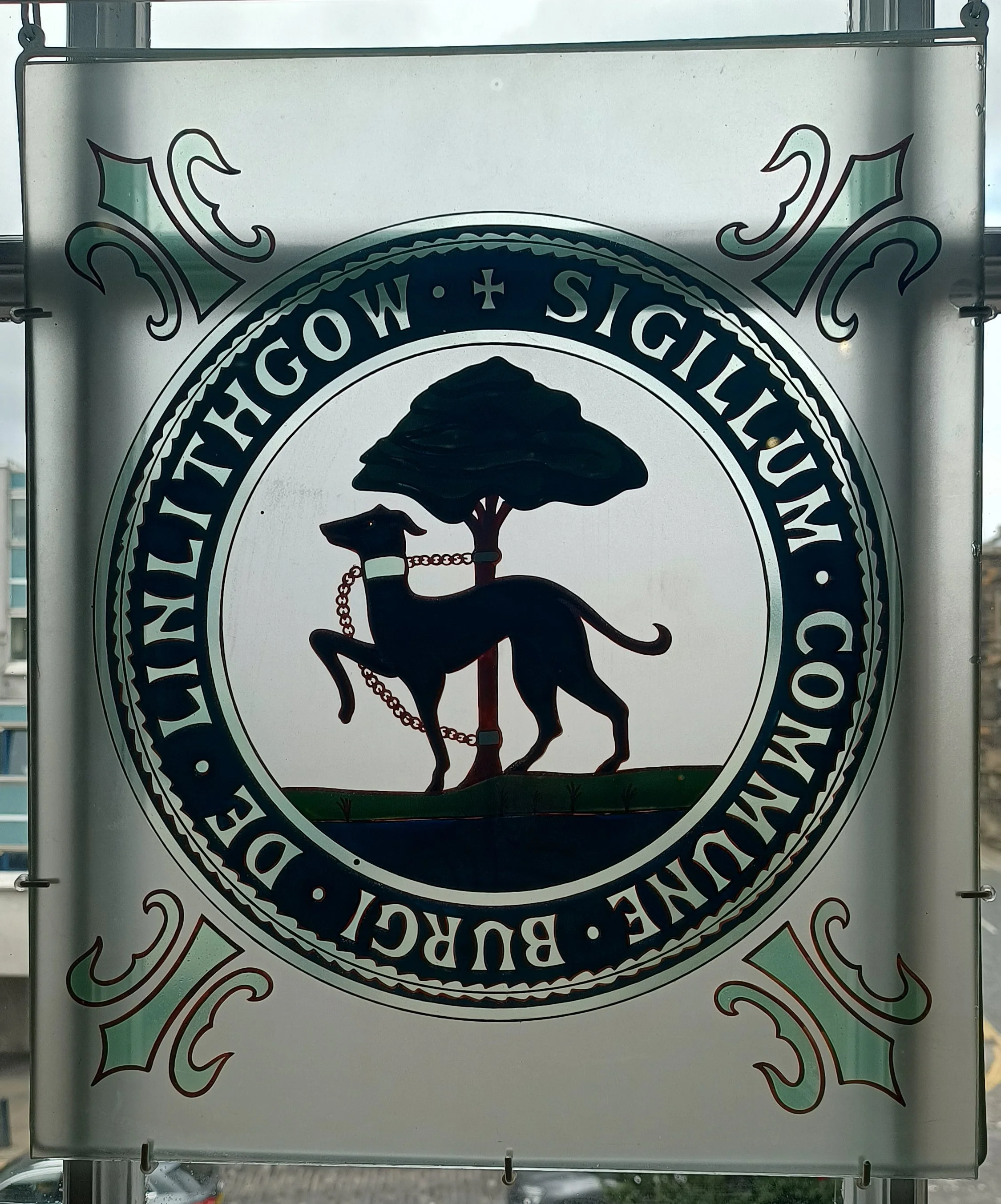
A glass etching of the Black Bitch
Are You a Black Bitch?
If you were born in Linlithgow, you may proudly call yourself a Black Bitch.
Yes, really.
Although, as with many long-standing local traditions, even that comes with a little debate.
Some Linlithgow people maintain that to be a true Black Bitch you must have been born within the historic boundary of the Royal Burgh, rather than simply having Linlithgow as your wider place of birth.
Other accounts simply describe those born in Linlithgow — or natives of Linlithgow — as Black Bitches.
We're not going to settle that particular local argument here!
What isn't in doubt is that within the town the name has traditionally been a term of identity and pride rather than an insult.
For generations of local families, being a Black Bitch has been part of their connection with Linlithgow. It is an identity that can stretch back through parents, grandparents and generations before them — linking people not only to the town, but to a shared story that has been told here for centuries.
And Linlithgow has produced some rather famous Black Bitches.
Some Famous Black Bitches
Perhaps the most famous Black Bitch of all is Mary, Queen of Scots, born at Linlithgow Palace in 1542.
There's John West, born in Linlithgow in 1809, whose name would eventually become familiar on supermarket shelves around the world.
Sir Charles Wyville Thomson, one of the fathers of modern day oceanography.
Alex Salmond, born in Linlithgow in 1954, went on to become Scotland's First Minister.
Then there's former Linlithgow MP Tam Dalyell.
Now, the strict interpretation of the rules might cause us a little difficulty with Tam.
Fortunately, Tam appears to have settled the matter himself.
Speaking in the House of Commons in 1996, he described himself as a Lithca lad and a “black bitch”, before explaining to anyone wondering what on earth he meant that the description applied to both men and women.
If Tam Dalyell called himself a Black Bitch in the House of Commons, we're not going to argue.
And there's one particularly famous Black Bitch who hasn't technically arrived yet:
Montgomery “Scotty” Scott, Star Trek's legendary engineer and Linlithgow's famous future son.
His Linlithgow story belongs several centuries in the future.
Black Bitches in Parliament
Tam wasn't the only person to bring Linlithgow's unusual local identity into parliamentary proceedings.
When Alex Salmond stood down as First Minister in 2014, fellow MSP Stewart Stevenson began his tribute by describing Salmond as having been born with:
“the overwhelming privilege of being a black bitch.”
He then explained the Linlithgow tradition and its connection with Fidelis — faithfulness.
It's difficult to think of a better demonstration of how differently the same words can be understood depending on their history and context.
When Words Change
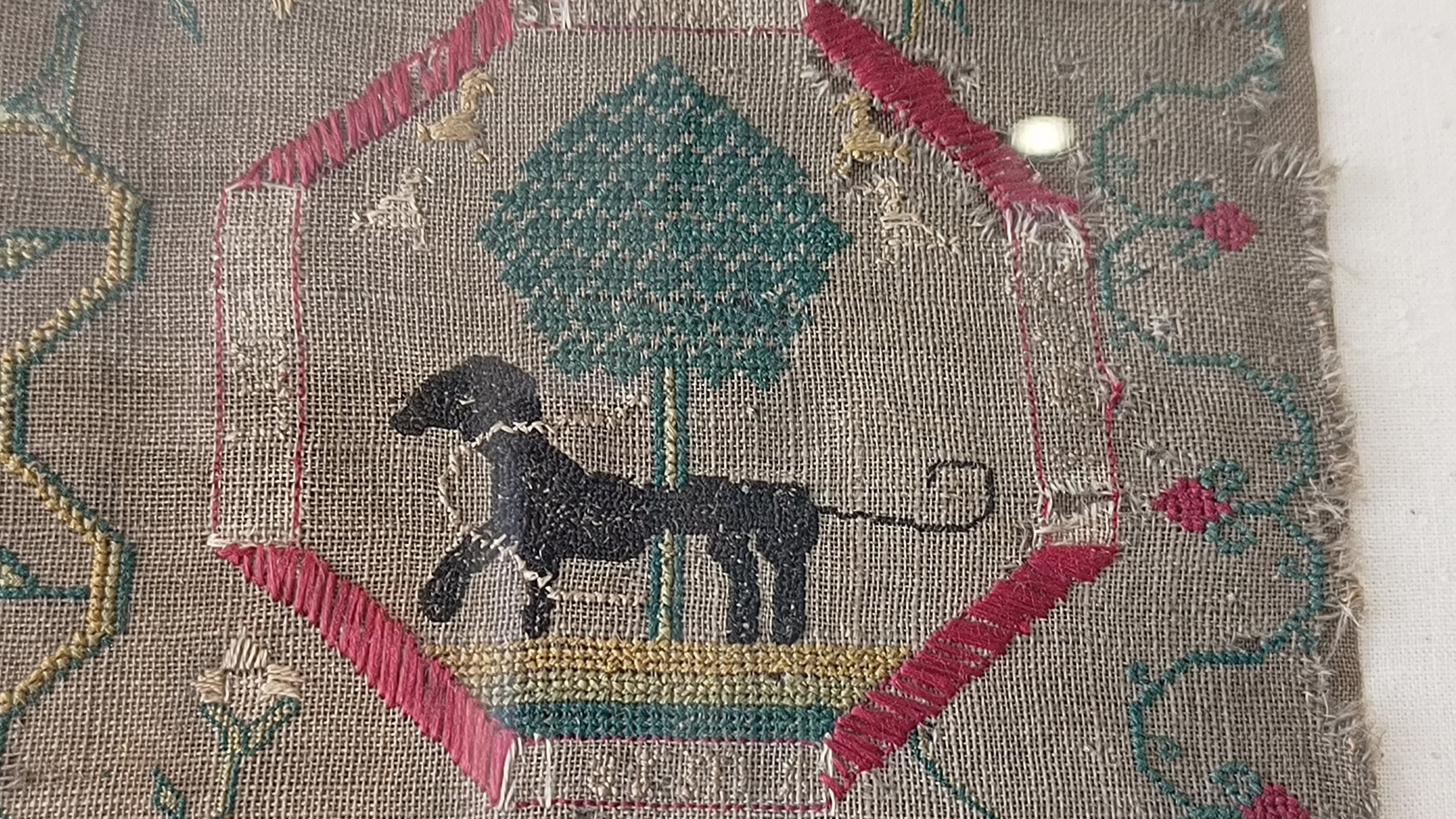
An embroidery sampler in Linlithgow Museum
Of course, language doesn't stand still.
To modern ears, the words “Black Bitch” can sound very different from their historical meaning in Linlithgow.
Today, bitch is frequently encountered as an insulting term for a woman. The combination of the words black and bitch can also understandably be interpreted very differently by someone who doesn't know the story.
But that isn't the historical meaning of Linlithgow's Black Bitch.
Here, black describes the colour of the animal and bitch means a female dog.
There is no known historical connection between Linlithgow's Black Bitch emblem and race, colonialism or slavery. The emblem itself has roots stretching back many centuries.
Recognising that history doesn't mean ignoring the way language has changed.
Instead, it reminds us that words can acquire new meanings over time, and that history, place and context matter.
Someone unfamiliar with Linlithgow may understandably need the name explained.
For generations of people here, however, being called a Black Bitch has meant something quite different.
It means you belong to Linlithgow.
The Pub That Started a Debate
That changing use of language became the centre of a major local controversy in 2021 and 2022.
For generations, one of Linlithgow's best-known pubs had been called the Black Bitch Tavern, taking its name from the town's historic emblem.
Its owner, Greene King, announced plans to rename it.
The company had been reviewing pub names following its acknowledgement of founder Benjamin Greene's historical links with transatlantic slavery. Although the company recognised the local origins of the Black Bitch name, it argued that language and meanings had changed and the words could now cause offence.
Many people in Linlithgow strongly disagreed.
For them, the name wasn't connected with slavery or race. It referred to an ancient symbol they associated with their town, their families and a story of loyalty they had grown up knowing.
The reaction was considerable.
The campaign to retain the name attracted thousands of supporters and eventually reached both the UK and Scottish Parliaments. Parliamentary motions recorded the antiquity of the emblem and the strength of local feeling surrounding it.
The disagreement also raised much bigger questions about heritage, language and identity.
Can the same words carry one meaning within a community and a very different meaning outside it?
What happens when language changes but a historic name remains?
And how do we preserve and explain local heritage while recognising that people encountering it without that context may understand it very differently?
There aren't necessarily simple answers.
The pub was eventually renamed The Willow Tree.
But part of the old Black Bitch Tavern has survived…
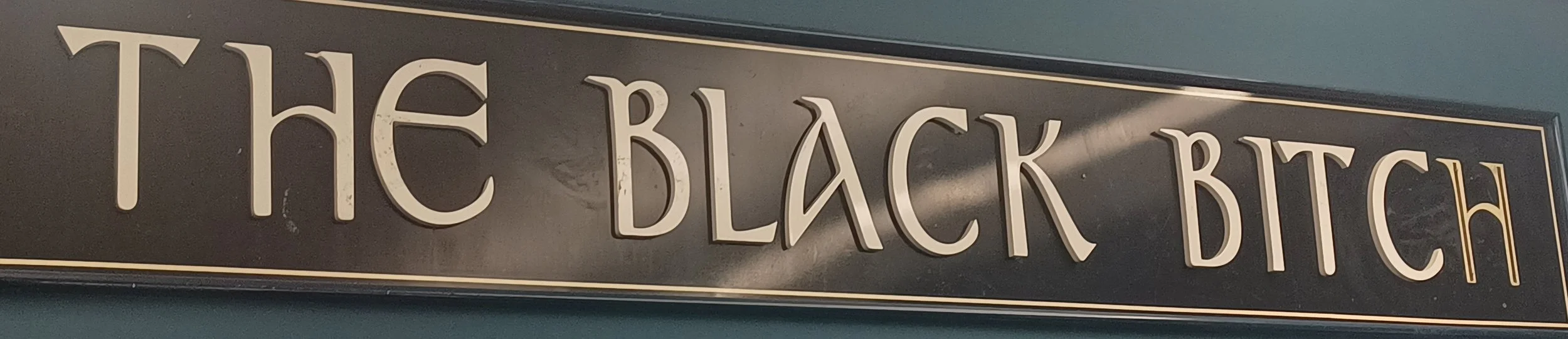
Historic Black Bitch sign displayed at Linlithgow Museum
An Old Sign With a New Story
Today, Linlithgow Museum cares for the former Black Bitch pub sign. That makes it much more than simply an old piece of pub signage.
Once, it told people the name of their local. Now it connects an ancient town symbol with a very modern debate about heritage, language, identity, inclusion and belonging.
Museums don't only preserve the distant past.
Sometimes history happens within living memory — and objects associated with it allow future generations to understand not only what happened, but why people cared so strongly about it.
The Black Bitch pub sign helps us preserve that story.
Find the Black Bitch
The best way to understand just how important the Black Bitch is to Linlithgow is simply to look for her.
You'll find versions of the dog throughout the town — painted, carved, sculpted, stitched, cast and incorporated into the symbols of local organisations.
And you'll find her throughout Linlithgow Museum too.
Once you know what you're looking for, you'll suddenly start seeing her everywhere.
Why not see how many Black Bitches you can spot as you explore Linlithgow?
Meet BB
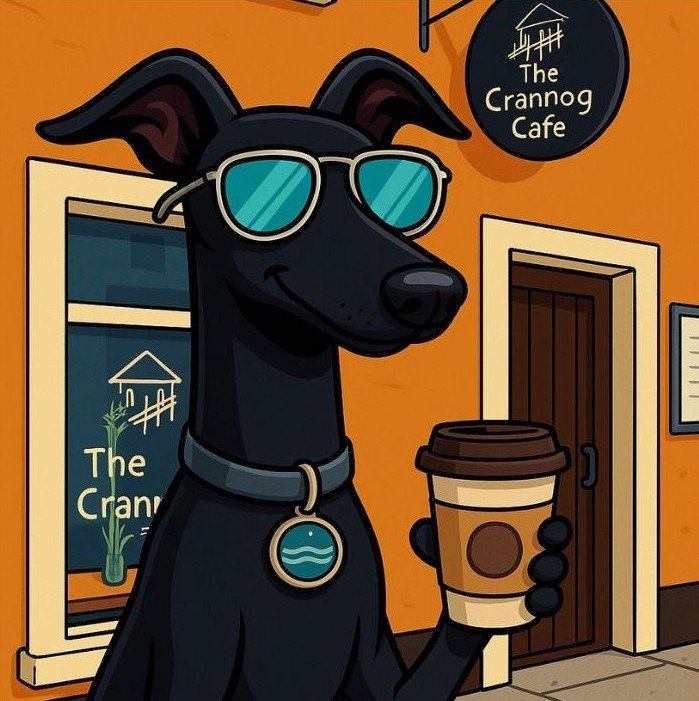
BB enjoying a squirrel-flavoured latte
The legend has even inspired one of Linlithgow Museum's more recent residents.
BB, our time-travelling museum dog, was inspired by Linlithgow's famous Black Bitch and helps younger visitors discover the stories of the town.
Curious, cheeky and always ready for an adventure, BB travels through different periods of Linlithgow's past, introducing children to the people, places and objects that have shaped the town.
She's our own way of allowing a centuries-old Linlithgow symbol to inspire a new generation.
Although, unlike her legendary predecessor, we generally try to keep BB away from islands, chains and angry medieval authorities.
More Than a Legend
We may never know whether there really was a faithful black greyhound swimming across Linlithgow Loch.
Perhaps there was.
Perhaps the emblem originated with the royal hunting dogs once familiar around Linlithgow Palace.
Perhaps several stories gradually became intertwined over hundreds of years.
And we're still not entirely sure what the witch was doing.
That's the nature of legends.
But the importance of the Black Bitch to Linlithgow is very real.
For centuries, her image has represented the town.
For generations, local people have proudly carried her name.
She has appeared on coats of arms, seals and buildings; in family identities and local organisations; in Westminster and Holyrood; in controversy and celebration — and throughout Linlithgow Museum.
And the qualities celebrated through her best-loved story remain remarkably simple:
Loyalty. Courage. Determination. Faithfulness.
So if you're visiting Linlithgow and hear someone proudly announce that they're a Black Bitch, don't be alarmed.
Now you know the story.
DID YOU KNOW?
The best-known version of the legend tells of a black female greyhound who swam across Linlithgow Loch carrying food and water to her imprisoned master.
Other traditions involve puppies, a fire and even a shape-shifting witch.
By the 1790s, the origins of the Black Bitch emblem were already uncertain.
One historical interpretation connects the dog with the royal hunting tradition around Linlithgow Palace.
Linlithgow has the unusual honour of having two historic coats of arms — the Black Bitch and St Michael.
Historic representations of the Black Bitch vary, but the dog, tree and connection with Linlithgow have endured.
Mary, Queen of Scots is Linlithgow's most famous Black Bitch.
The term has been used proudly in both the House of Commons and the Scottish Parliament.
Exactly who qualifies as a true Black Bitch remains the subject of a little friendly local debate.
Linlithgow Museum cares for the former Black Bitch Tavern sign, preserving a modern chapter in the story of the town's ancient emblem.
And BB, the Museum's time-travelling dog, continues the Black Bitch tradition for a new generation.